


Saving Arizona Time, Money and Hassle with Quality Commercial Solar Solutions and Dependable Service, Since 1999.
Give people a reason to choose your business — solar carports deliver shade, savings, and visible sustainability.
Solar parking structures in Phoenix, AZ, provide clean energy while offering shaded, protected parking—perfect for commercial spaces looking to maximize ROI from underused areas. While we don’t build the structures, we specialize in expertly wiring and installing the solar arrays on top as part of our professional solar parking lot canopy installation services in Arizona.
Commercial solar canopies and solar carport installation in Phoenix, Arizona, can transform parking lots into energy-generating assets while providing valuable shade for customers and employees. These commercial solar canopy systems provide shade, improve sustainability, and make your business more attractive to customers. Here are some of the best places they work:
Covered parking keeps employees cool while reducing operating costs.
Solar carports provide shade and energy savings for residents while boosting property value.
Dual-purpose solar canopies provide covered parking and clean energy for public spaces, making them some of the best solar canopies for Arizona.
Shaded lots attract more customers and showcase your business’s commitment to sustainability.
Installing commercial solar carports isn’t just about panels—it’s about protecting your investment and your reputation. Watt Masters has the electrical expertise and solar know-how to seamlessly integrate Arizona commercial solar garage canopies into your parking lot without the headaches. From precise wiring to flawless panel installation, we’re the trusted partner Arizona businesses rely on to get it done right.
Projects Completed
Panels Installed
5★ Reviews
In-House Crew
I have been working with Tom Buehler for the past thirteen years. They have completed several commercial projects for our business. It is rare to find such a professional company that offers outstanding customer service along with quality workmanship.
Please consider this an enthusiastic recommendation for Watt Masters, who's worked with me on solar installations since 1998, from 5 kW to 2.4 mW (24 panels to 8,000). Empire has awarded $3m+ and we plan to maintain this successful relationship for years to come.
Regarding the very functional 62.5 KwH covered parking solar system for our congregation. The entire process was handled professionally. Most importantly, any issues that arose were continually addressed and resolved. Job site was neat and tidy. Staff polite and helpful.
A solar carport installation for businesses is a parking lot structure designed to support solar panels above parked vehicles. It gives Arizona businesses two major benefits at once: shaded parking for employees and customers, and on-site solar energy production that helps reduce electricity costs. These solar shade structures in Phoenix, AZ can also make better use of existing parking areas.
A commercial solar carport works by mounting solar panels on a purpose-built overhead structure above parking spaces. Those panels capture Arizona sunlight and convert it into electricity, which is then sent through inverters and used to help power your commercial property. In Phoenix, this is especially valuable because strong sun exposure and high daytime energy usage make solar parking lots highly productive.
Arizona commercial solar carports offer several major advantages for businesses, including:
For many properties, solar carports are one of the smartest ways to turn a passive parking area into a revenue-producing asset.
The cost of a solar carport installation in Arizona depends on system size, structural design, site conditions, and electrical requirements. Solar carports usually cost more upfront than rooftop solar because they require steel structures and additional engineering, but they also provide added value through shaded parking, better visibility, and long-term energy savings. A custom site assessment is the best way to get accurate pricing for commercial solar canopy projects.
That depends on the property. Rooftop solar is often the most cost-effective option when the building has enough usable roof space. Solar shade parking and commercial solar canopies are a strong choice when roof space is limited, unsuitable, or when the business wants the added benefit of shaded parking. In many Phoenix commercial properties, solar carports in Arizona also improve customer experience while generating clean energy.
Most commercial solar canopy installation projects take several weeks to several months from design to final activation. The exact timeline depends on project size, permitting, engineering, utility coordination, and site conditions. In Phoenix, starting early is smart, especially before the busiest summer construction season. Working with experienced solar canopy contractors can help businesses navigate the electrical installation and project requirements.
Yes. Solar carports are built to perform in Arizona’s harsh climate. In fact, Phoenix’s intense sun is exactly what makes solar carports such a smart investment. Modern commercial solar panels are engineered for high temperatures, and the elevated carport design allows for airflow that helps support strong energy production.
Yes. Depending on the project and current eligibility rules, commercial solar carport installations in Arizona may qualify for federal tax credits, accelerated depreciation, and Arizona-specific tax advantages. Because incentives can significantly reduce the effective cost of a project, it’s worth working with an experienced commercial solar EPC partner who can help you capture every available benefit.
Commercial solar carports turn an existing parking lot into an energy-producing asset without requiring additional land. For Phoenix businesses, they provide the added benefit of shaded parking in Arizona’s intense sun while generating electricity that can help offset the property’s daytime energy use.
A properly designed solar parking canopy can also provide several benefits at once:
For properties with large parking areas, a solar carport can solve two problems with the same piece of real estate: where to generate solar power and how to provide better covered parking.
A commercial solar carport may add value to a property by combining on-site energy infrastructure with covered parking, but there isn’t a universal percentage increase that applies to every building.
The value depends on factors such as the solar system’s age and condition, energy production, ownership or financing structure, remaining useful life, utility savings, parking demand, EV-charging capabilities, and the local commercial real estate market.
From a property owner’s perspective, the bigger question is often broader than appraisal value. A well-designed solar carport can improve the usefulness of the property by adding shade and energy-producing infrastructure without consuming additional developable land.
Commercial solar carports generally require preventive maintenance similar to other commercial photovoltaic systems, along with inspection of the elevated steel structure and parking-area components.
A maintenance program may include:
Phoenix adds another consideration: dust. Arizona’s dry conditions and major dust events can leave significant soiling on panels, so cleaning should be based on site conditions and monitored production rather than an arbitrary schedule alone.
Regular commercial solar maintenance helps identify small problems before they become lost production, electrical failures, or more expensive repairs.
Phoenix is particularly well suited for commercial solar carports because businesses can take advantage of Arizona’s strong solar resource while creating something people immediately appreciate: shade.
Anyone who’s crossed a Phoenix parking lot in July understands that covered parking isn’t a throwaway benefit. For office buildings, medical facilities, shopping centers, schools, dealerships, warehouses, multifamily properties, and other commercial sites, a solar canopy can improve the parking experience while producing electricity above the same pavement.
The actual financial benefit depends on system size, utility rate, energy usage, site conditions, financing, and project cost, so every property should be evaluated individually.
They shouldn’t when the system is properly designed around the existing parking layout.
Columns can typically be positioned along stall lines, at the ends of spaces, or between opposing rows so vehicles can continue using the same parking area. The design also needs to account for ADA-accessible spaces, access aisles, fire lanes, vehicle turning areas, delivery routes, landscaping, and required clearances.
There may be temporary parking disruptions while foundations and steel are installed. Before construction, the site plan should clearly show the existing and proposed parking count so the property owner knows exactly how the finished layout will function.
Yes. Solar carports are particularly well suited for EV charging because the canopy’s columns and electrical infrastructure can provide logical locations for chargers, conduit, and related equipment.
For businesses planning future EV charging, it usually makes sense to address it during the original solar carport design. Conduit paths, electrical capacity, charger locations, accessible EV spaces, and future load requirements can then be considered before foundations are poured and the parking lot is restored.
The solar array doesn’t necessarily need to supply each charger directly. The building’s electrical system, solar production, utility service, charging demand, and potentially battery storage can be engineered together as one energy strategy.
A properly engineered commercial solar carport is a long-term piece of infrastructure. The structural system can be designed for a service life measured in decades, while solar modules commonly carry long-term performance warranties.
Individual components don’t necessarily have identical lifespans. Inverters, monitoring equipment, electrical components, coatings, and other equipment may require service or replacement during the life of the array.
That’s why Watt Masters recommends looking beyond the panels themselves. The steel, foundations, electrical work, drainage, equipment access, and long-term serviceability all matter when you’re building something expected to remain over an active parking lot for decades.
Solar carports typically cost more per watt than a comparable rooftop installation because the project requires foundations, substantial structural steel, elevated construction, and additional civil and electrical work.
That doesn’t necessarily make rooftop solar the better choice.
A solar carport provides benefits a rooftop array can’t, including shaded parking, productive use of parking-lot space, easier integration with EV charging, and additional solar capacity when the roof is too small, structurally unsuitable, or needed for other equipment.
For some commercial properties, the best solution may even combine rooftop solar and solar carports to maximize on-site generation.
Yes. Existing commercial parking lots can often be retrofitted with solar carports, but the site needs to be evaluated before the structure is designed.
A professional assessment should consider the existing parking layout, underground utilities, soil and foundation conditions, fire lanes, ADA access, drainage, vehicle heights, landscaping, electrical service, utility interconnection, and available space for solar equipment.
The condition of the asphalt alone doesn’t determine whether a carport can be installed. The canopy is supported by engineered foundations below the parking surface, so subsurface conditions and underground utilities are especially important.
There isn’t a reliable one-size-fits-all number because solar carport production depends on the number of covered spaces, available canopy area, module wattage, orientation, tilt, shading, equipment efficiency, and site-specific solar conditions.
A commercial solar contractor should model both the proposed system’s kW capacity and estimated annual kWh production rather than simply quoting a number of panels.
For Phoenix businesses, that production should then be compared with the property’s actual electrical usage and utility rate structure to determine how much of the generated electricity can provide value on site.
Yes. Commercial solar carports can be integrated with battery energy storage when the property’s electrical infrastructure, project goals, and economics support it.
Battery storage can give a business more control over when solar energy is used. Depending on the system design and utility rate, storage may be used for demand management, time-of-use optimization, critical-load backup, EV-charging support, or a broader microgrid strategy.
The battery should be sized from the facility’s actual load profile and intended use, not simply matched to the solar array’s nameplate capacity.
They can be when properly engineered for the site. A commercial solar canopy is a substantial elevated structure, so wind loading, foundations, structural connections, drainage, electrical equipment, and local code requirements need to be addressed during engineering.
Phoenix-area projects should also account for vehicle impact, emergency access, fire lanes, drainage during heavy monsoon rainfall, and the types of vehicles that will pass beneath the structure.
This is one reason commercial carports shouldn’t be treated like oversized residential solar installations. The structural, civil, and electrical engineering all need to work together.
Commercial solar carports are especially worth evaluating for properties with large, open parking areas and meaningful daytime electricity consumption.
Common candidates include:
The best candidate isn’t simply the property with the biggest parking lot. The strongest projects align available parking area, solar exposure, electrical demand, utility economics, and long-term property plans.
Start with a professional site assessment rather than estimating from the number of parking spaces alone.
For a Phoenix commercial solar carport project, Watt Masters evaluates factors such as available parking area, solar exposure, parking and traffic patterns, ADA and fire access, underground utilities, foundation requirements, electrical infrastructure, utility interconnection, vehicle clearances, drainage, and the property’s energy usage.
From there, the parking lot can be mapped with a proposed canopy layout, estimated system size, and projected solar production. That gives the property owner something much more useful than a generic price per panel: a solar design based on how the property actually works.
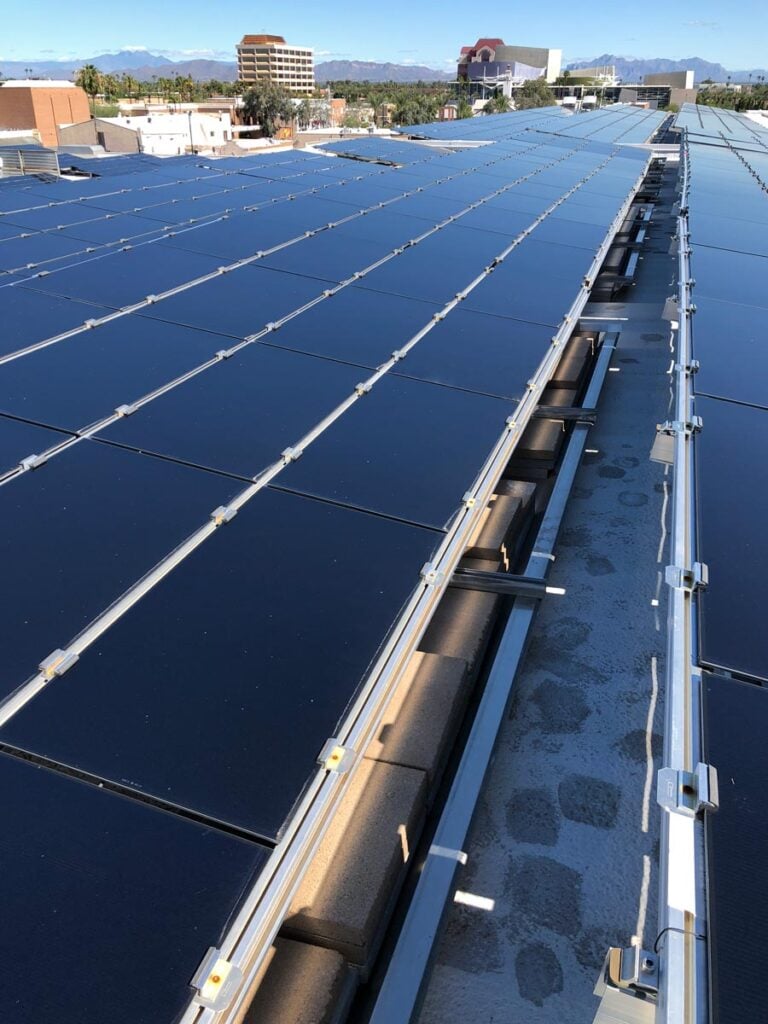
With countless installs on small offices to massive warehouses, rooftops are our specialty.
Solar carports & canopies save costs, generate great power, and shade vehicles below.
Ground-mount solar is a great option when roof space is limited and land is available.